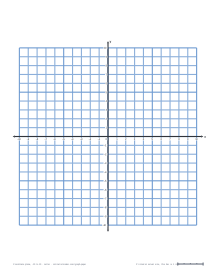
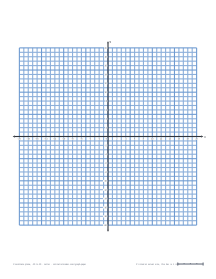
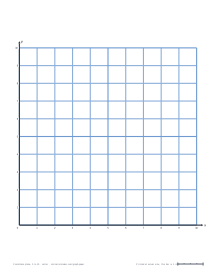
The parts of a coordinate plane
Two number lines cross at right angles at zero. The horizontal one is the x-axis, the vertical one the y-axis, and the point where they cross is the origin, (0, 0). Every point is named by an ordered pair (x, y): go across first, then up or down.
The axes cut the plane into four quadrants, numbered with Roman numerals counter-clockwise from the top right: Quadrant I (x and y both positive), II (x negative, y positive), III (both negative) and IV (x positive, y negative). Points that sit on an axis are in no quadrant.
Making a worksheet
- Four or six per page gives one plane per question. Six per page still leaves cells about ⅛ inch wide at −10 to 10 on Letter.
- Bigger ranges (−20 to 20, −30 to 30) keep cells readable by labelling every 2nd or 5th number; the generator steps labels up automatically if they would touch.
- First quadrant only (0 to 10 or 0 to 20) is how coordinates are first taught, usually in grade 5. There is a page set up for that: coordinate grid.
Questions
What are the four quadrants?
Quadrant I is top right (+, +), II is top left (−, +), III is bottom left (−, −) and IV is bottom right (+, −). They are numbered counter-clockwise starting at the top right.
Which number comes first in a coordinate pair?
The x value (across), then the y value (up or down). (3, −2) is 3 to the right of the origin and 2 down.